Medical Director, Medical Office Force LLC | Athens, Georgia
Alumnus: SMS Medical College, Emory University, University of Alabama at Birmingham
Last updated on April 9, 2026
Introduction
Welcome to Athens Heart Center and Specialty Clinics. With more than 30 years of medical experience and advanced fellowship training from Emory University, my approach to patient care in Athens, GA has always been deeply integrated.
As a physician certified in both cardiovascular disease and sleep medicine, I do not see sleep as a luxury or a lifestyle choice. I see it as a core part of human physiology.
Every day at our clinic on Prince Avenue, I see a direct and powerful connection between how you sleep at night and how your heart functions during the day. When sleep is disrupted, both your heart and brain begin to suffer.
The Impact of Untreated Chronic Insomnia
Chronic insomnia is not simply an inconvenience. It represents a state of ongoing physiological stress. When it is left untreated, it disrupts the hypothalamic pituitary adrenal axis, increases activity in the sympathetic nervous system, and triggers widespread inflammation in the body.
This constant state of stress increases the risk of high blood pressure, coronary heart disease, and heart failure. Learn more about how insomnia is diagnosed and treated: https://www.ahcsleepcenter.com/insomnia/
The effects are not limited to the heart. The brain is equally affected. Persistent insomnia with reduced sleep has been linked to faster cognitive decline, similar to adding several extra years of aging. It is also associated with increased amyloid buildup and damage to white matter in the brain.
At Athens Heart Center, our goal is not just to improve sleep, but to improve your overall health span. We identify the specific type of insomnia you are experiencing and provide targeted evaluation and treatment in one place.
Advanced Therapies: SleepioRx and Non Pharmacological Care
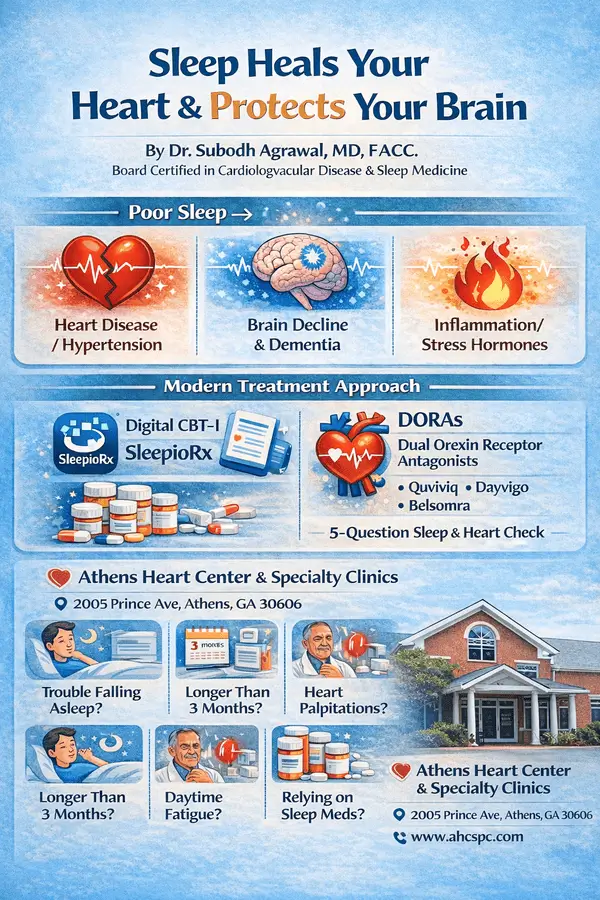
Our approach begins with non medication based treatments whenever possible. One of the key tools we use is SleepioRx, a prescription digital therapeutic that delivers cognitive behavioral therapy for insomnia.
This program works by retraining your brain and sleep patterns in a structured and personalized way. It has been shown to improve sleep outcomes while also reducing overall healthcare costs, without the need for medication.
Pharmacological Management and Safer Modern Options
While digital therapies are often effective, medication can still be an important part of treatment for some patients. The choice of medication plays a critical role in both sleep quality and long term safety.
For many years, treatment relied on medications such as benzodiazepines and non benzodiazepine drugs like zolpidem or eszopiclone. These medications act by suppressing activity across the central nervous system, creating a sedative effect.
Long term use of these medications carries significant risks. Research shows a strong association with cardiovascular disease, including heart failure and rhythm disorders.
From a neurological perspective, these medications interfere with natural sleep cycles. This can lead to daytime drowsiness, memory issues, and increased risk of falls or fractures, especially in older adults.
They also carry a high risk of tolerance and physical dependence, meaning higher doses may be needed over time to achieve the same effect.
The Modern Alternative: DORA Medications
A newer and safer approach involves medications known as dual orexin receptor antagonists. These include daridorexant, lemborexant, and suvorexant.
Instead of forcing the brain into sedation, these medications work by reducing wake signals in the brain. This allows the body to fall asleep in a more natural way.
Clinical evidence shows that these medications preserve healthy sleep patterns and do not lead to dependence or rebound insomnia after stopping treatment. They are also considered safer for patients with heart and respiratory conditions, including those with disorders like narcolepsy and hypersomnia: https://www.ahcsleepcenter.com/narcolepsy/ https://www.ahcsleepcenter.com/idiopathic-hypersomnia/
How to Safely Stop Older Sleep Medications
If you are currently using older sleep medications, it is important not to stop them suddenly. Abrupt discontinuation can lead to serious withdrawal symptoms such as seizures, confusion, and severe anxiety.
A safe approach involves gradual dose reduction under medical supervision. Typically, doses are reduced slowly over several weeks to minimize withdrawal effects.
At our clinic, we guide patients through this process while introducing safer treatment options. This helps maintain sleep quality while reducing dependence on older medications.
The 12 Minute Sleep and Heart Check
Ask yourself the following questions. If you answer yes to two or more, it may be time to seek a professional evaluation.
Do you take more than 30 minutes to fall asleep or wake frequently during the night
Have these sleep issues continued for at least three months
Do you feel tired, irritable, or mentally foggy during the day
Do you have high blood pressure, heart concerns, or notice palpitations when exhausted
Do you rely on sleep aids, alcohol, or prescription medications to fall asleep
Chronic insomnia is a medical condition defined by difficulty falling or staying asleep for at least three months, occurring multiple times per week, and affecting daily functioning.
How does poor sleep affect the heart
Healthy sleep allows blood pressure to drop naturally at night. Insomnia prevents this, placing continuous stress on the cardiovascular system and increasing inflammation.
Can insomnia affect brain health
Yes. Chronic insomnia is associated with faster cognitive decline and increased buildup of proteins linked to neurodegenerative conditions.
Are over the counter sleep aids safe
Most over the counter options rely on antihistamines. These can cause next day drowsiness and do not address the underlying cause of insomnia.
What is SleepioRx
SleepioRx is a prescription based digital therapy that delivers cognitive behavioral therapy for insomnia through a structured online program.
What are the safest medication options today
Modern medications such as dual orexin receptor antagonists support natural sleep by reducing wake signals in the brain, without causing dependence.
Is it possible to reverse the effects of insomnia
Yes. With proper diagnosis and evidence based treatment, it is possible to restore healthy sleep and reduce long term risks to the heart and brain.
Sleep is not optional. It is a critical component of your heart health and brain function.
If you are struggling with ongoing sleep issues, seeking timely evaluation can make a meaningful difference. With the right approach, it is possible to restore healthy sleep, protect your heart, and support long term cognitive health.
If you are experiencing persistent sleep problems, consider scheduling an evaluation at Athens Heart Center and Specialty Clinics or explore more insights on our blog: https://www.ahcsleepcenter.com/post/.
Associations of chronic insomnia, longitudinal cognitive outcomes, amyloid-PET, and white matter changes in cognitively normal older adults – PMC, accessed March 15, 2026, https://pmc.ncbi.nlm.nih.gov/articles/PMC12425456/
Cost Savings Associated With Fully Automated Digital Cognitive Behavioral Therapy for Insomnia Disorder (SleepioRx) – Journal of Health Economics and Outcomes Research, accessed March 15, 2026, https://jheor.org/article/146434.pdf
Successful Methods for Switching from a Benzodiazepine Receptor Agonist to a Dual Orexin Receptor Antagonist for the Treatment of Insomnias – PMC, accessed March 15, 2026, https://pmc.ncbi.nlm.nih.gov/articles/PMC12559944/


Share Your Thoughts
No comments yet — be the first to comment!