

For over three decades practicing cardiology and sleep medicine right here in the Classic City, I have sat across from thousands of my fellow Athens residents who share the exact same complaint: "Dr. Agrawal, I am getting eight hours of sleep, but I wake up feeling like I haven't slept at all."
Many of these patients walk through our doors at 2005 Prince Avenue struggling with stubborn, hard-to-control high blood pressure, recurring atrial fibrillation (AFib), or terrifying daytime drowsiness while driving down Epps Bridge Parkway or commuting near the UGA campus.
As I emphasized in my previous clinical publication ("Beyond the 4 Vitals: Why Sleep is the Secret to Heart Longevity"), your heartbeat and your breathing are telling the exact same story. When Obstructive Sleep Apnea (OSA) repeatedly starves your body of oxygen overnight, your sympathetic nervous system fires, your blood pressure spikes, and your heart strain doubles. Sleep is not a luxury-it is the fifth vital sign.
Taking the first step toward diagnosis is vital, but patients in Clarke County and surrounding Northeast Georgia are often paralyzed by choice and expense: Should you get an At-Home Sleep Apnea Test (HSAT) or a hospital-based In-Lab Polysomnography (PSG)?
Let us break down the exact costs, clinical capabilities, and fastest local treatment pathways.
Direct Cost & Logistical Comparison: At-Home vs. Hospital-Based Sleep Studies
One of the largest hurdles to receiving proper sleep care in Athens is financial surprise. Hospital-based sleep laboratories typically subject patients to "facility billing"-meaning you receive two bills: one for the hospital facility room and one for the physician interpreting the data. Independent accredited practices bill under standard, transparent physician office codes.
| Cost & Logistical Factor | At-Home Sleep Test (HSAT) | Hospital / In-Lab Study (PSG) |
|---|---|---|
| Testing Location | Your own bed in Athens, GA | Overnight hospital or sleep lab room |
| Typical Cash / Self-Pay Rate | $199 flat rate (Includes device, physician interpretation, & follow-up) | $1,800-$4,500+ (Combined facility and physician fees) |
| Average Insured Out-of-Pocket | $0-$100 (First-line diagnostic preference) | $500-$1,500+ (Subject to high hospital deductibles) |
| Monitored Parameters | 3-4 core channels (Airflow, SpO2 pulse, chest effort) | 20+ channels (EEG brainwaves, ECG, EMG, eye movement) |
| Appointment Wait Time | Same-day or within 48 hours | 4 to 12 weeks waitlist |
| Supervision | Unattended / Self-administered | Overnight Sleep Technologist |
Note: Athens Sleep and Wellness Center accepts Medicare, Medicaid, and major commercial insurance carriers. For uninsured or high-deductible patients, our $199 cash option ensures care remains immediately accessible.
The Clinical Breakdown: Which Test Do You Actually Need?
Both testing modalities serve valid medical purposes, but they are designed for vastly different patient profiles.
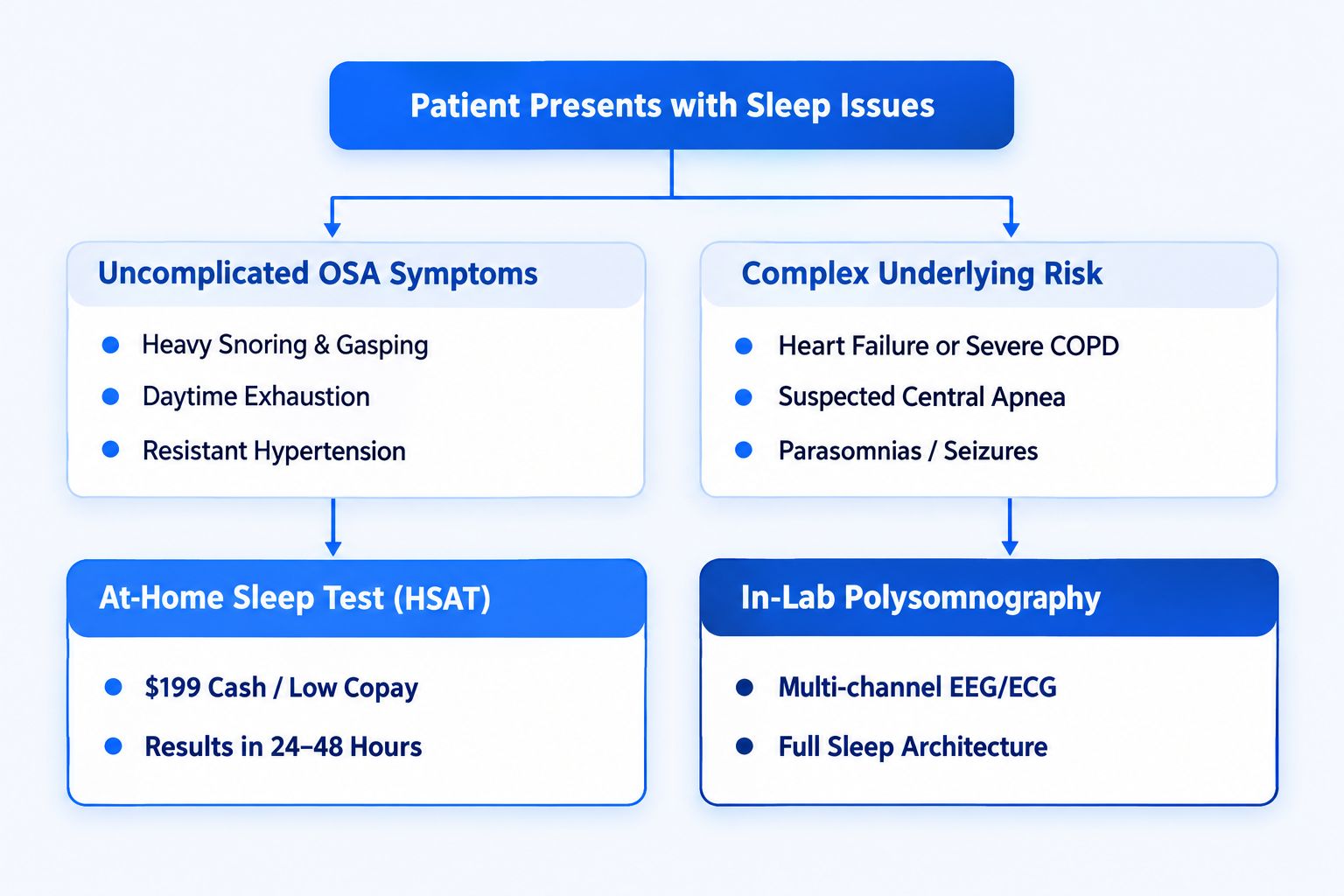
Patient Presents with Sleep Issues
Option 1: At-Home Sleep Apnea Test (HSAT)
An at-home sleep test utilizes an FDA-cleared, lightweight device (such as the WatchPAT) that you wear in your own bed.
What It Measures: Airflow, heart rate, blood oxygen drops (SpO2) and chest movement.
When It Is Right for You: Indicated for adult patients with a high clinical likelihood of uncomplicated Obstructive Sleep Apnea who do not suffer from severe co-existing cardiopulmonary disease.
Key Advantages: Unmatched comfort, total convenience, low out-of-pocket costs, and rapid turnaround time.
Option 2: In-Lab Overnight Polysomnography (PSG)
An in-lab study takes place overnight at a dedicated facility where an overnight sleep technologist monitors your biological signals.
What It Measures: Full neurological brainwaves (EEG) to track exact sleep stages (REM vs. Non-REM), eye movements (EOG), leg movements (EMG), continuous heart rhythm (ECG), and complex respiratory mechanics.
When It Is Right for You: Required for patients with complex medical conditions-including congestive heart failure, advanced COPD, suspected central sleep apnea, narcolepsy, or parasomnias (such as sleepwalking).
Key Advantages: Comprehensive diagnostic scope for non-respiratory sleep disorders.
Story: From Exhaustion to Recovery in 48 Hours with APAP
To understand how modern sleep medicine saves both health and money, consider a typical case from our Prince Avenue clinic:
The Patient: Marcus, a 48-year-old high school administrator in Clarke County, was referred to my office after his primary physician struggled to control his Stage 2 hypertension despite prescribing three separate blood pressure medications. Marcus was chronically exhausted, snoring loudly, and falling asleep at his desk.
The Old Hospital Route: Marcus initially called a regional hospital sleep center. He was informed of a 10-week waitlist for an in-lab study, with an estimated out-of-pocket facility cost of $1,400 applied toward his unmet deductible.
The Athens Sleep & Wellness Fast-Track Pathway:
- Monday Afternoon: Marcus walked into Athens Sleep and Wellness Center at 2005 Prince Ave. After a combined cardiovascular and airway clinical evaluation, he was handed a portable home sleep testing device.
- Monday Night: Marcus slept in his own bed in Athens, wearing a simple wrist sensor and finger probe.
- Tuesday Morning: He returned the device to our office. I evaluated his digital data trace, diagnosing severe Obstructive Sleep Apnea with an Apnea-Hypopnea Index (AHI) of 34 events per hour and blood oxygen drops down to 81%.
- Tuesday Afternoon: Instead of ordering a second, expensive $1,500 overnight in-lab "CPAP titration study," I prescribed an Auto-titrating Positive Airway Pressure (APAP) machine. Modern APAP devices use real-time algorithms to adjust pressure breath-by-breath based on airway resistance, completely eliminating the need for an in-lab titration night.
- Wednesday Night: Marcus slept with his APAP device.
- Thursday Morning: He woke up having slept 7 uninterrupted hours with zero apnea events. Within three weeks of consistent therapy, Marcus's resting systolic blood pressure dropped by 14 mmHg, allowing his doctor to reduce his blood pressure medication.
10 FAQs: Finding the Most Cost-Effective Sleep Care Strategy in Athens, GA
1. What is the cheapest way to get tested for sleep apnea in Athens, GA?
The most cost-effective diagnostic option is an At-Home Sleep Apnea Test (HSAT). At Athens Sleep and Wellness Center, our transparent self-pay rate is $199 flat, which covers the device pickup, comprehensive interpretation by a board-certified physician, and your follow-up results consultation.
2. Will my health insurance cover an at-home sleep study?
Yes. Most commercial insurance plans (including BlueCross BlueShield of Georgia, Aetna, Humana, and United Healthcare), as well as Medicare, explicitly prefer or require an at-home sleep study as the initial diagnostic step because it delivers clinical accuracy at a fraction of hospital costs.
3. How do I avoid hidden "facility fees" when getting a sleep study in Clarke County?
To avoid facility fees, choose an independent, accredited outpatient medical practice rather than a hospital-based outpatient department. Independent specialty clinics bill under standard physician office codes, preventing secondary hospital bills that can add $1,000+ to your balance.
4. What is the main difference between standard CPAP and Auto-CPAP (APAP)?
Traditional CPAP delivers one fixed air pressure, which historically required a second $1,500+ overnight in-lab pressure titration study. An Auto-CPAP (APAP) uses built-in smart sensors to automatically adjust pressure breath-by-breath throughout the night, saving you the time and expense of a second study.
5. When is an in-lab overnight sleep study medically necessary?
An in-lab study (Polysomnography) is medically necessary if you have complex conditions like heart failure, severe pulmonary disease, suspected central sleep apnea, narcolepsy, or parasomnias-or if a previous home study yielded inconclusive results despite strong clinical symptoms.
6. Can my cardiologist manage my sleep apnea, or do I need two separate specialists?
Because sleep apnea directly triggers cardiac conditions like AFib, resistant hypertension, and heart failure, integrated care is optimal. Holding double board certifications in both Cardiovascular Disease and Sleep Medicine allows our practice to evaluate and treat your heart rhythm and airway health in a single office visit without multiple copays.
7. How quickly can I schedule a sleep test appointment in Athens?
While hospital-based sleep centers often have waiting lists ranging from 1 to 3 months, Athens Sleep and Wellness Center offers same-day or 48-hour appointment availability for home sleep test evaluations.
8. What happens if my home sleep test comes back negative?
A negative home test does not mean your exhaustion isn't real. If symptoms persist but your home test is negative for sleep apnea, we proceed to an in-lab polysomnogram to investigate non-respiratory causes, such as restless legs syndrome or sleep architecture disruptions.
9. Can I use data from my Apple Watch or Oura Ring instead of a sleep study?
No. While smartwatches and fitness wearables provide helpful lifestyle trends, they are not FDA-cleared diagnostic medical devices. They cannot measure actual respiratory effort or blood oxygen desaturation accurately, and insurance plans will not authorize treatment based on consumer wearable data.
10. Where is Athens Sleep and Wellness Center located, and how do I schedule?
Our practice is located in the Prince Avenue medical corridor at 2005 Prince Avenue, Athens, GA 30606. You can schedule a consultation directly by calling (706) 613-6990 or visiting us online at ahcsleepcenter.com.
References & Clinical Citations
- Agrawal, S. K. (2026). Beyond the 4 Vitals: Why Sleep is the Secret to Heart Longevity. Athens Heart Center & Specialty Clinics Clinical Publications.
- Kapur, V. K., et al. (2017). Clinical Practice Guideline for Diagnostic Testing for Adult Obstructive Sleep Apnea: An American Academy of Sleep Medicine Clinical Practice Guideline. Journal of Clinical Sleep Medicine, 13(3), 479-504.
- American College of Cardiology (ACC). Obstructive Sleep Apnea and Cardiovascular Disease: Shared Pathophysiology and Integrated Management Protocols.
- Athens Sleep and Wellness Center. Diagnostic Protocols for Outpatient Home Sleep Apnea Testing (HSAT). Located at 2005 Prince Ave, Athens, GA 30606.